Journal
How Long Do Middle Eastern Leftovers Keep?
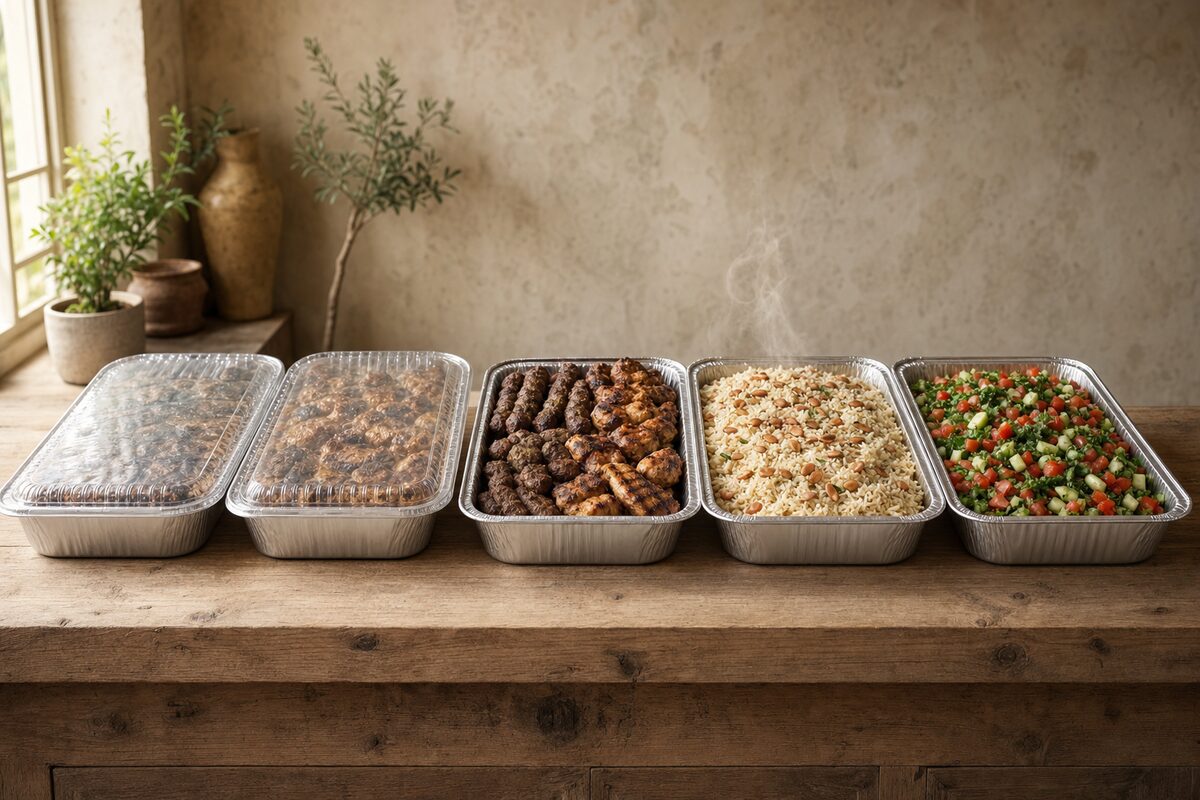
Health Canada advises eating refrigerated leftovers within 2 to 3 days or freezing them, and its storage table allows 3 to 4 days for cooked meat, stews and vegetable dishes. Cool them fast in shallow uncovered containers, keep the fridge at 4°C or lower, and remember the clock starts when the food comes off the heat.
This guide sets out the day counts by food type, explains when the countdown really begins, and covers what freezes well in a Middle Eastern spread and what does not.
How many days do leftovers actually keep?
Between two and four days for most cooked dishes, depending on which Health Canada page you read and what the dish is. That is not a contradiction so much as a conservative rule sitting next to a detailed table.
Health Canada’s guidance on leftovers gives the simple version: eat refrigerated leftovers within 2 to 3 days, or freeze them for later use. Its safe food storage table is more granular and slightly more generous, allowing 3 to 4 days for cooked meat, stews, egg or vegetable dishes, and the same 3 to 4 days for cooked poultry and fish, while holding soups to 2 to 3 days.
Our reading, and the one we would give a family member: use 2 to 3 days as the number you plan around, and treat the fourth day as an outer limit for a dish that was cooled quickly and kept properly. Health Canada is explicit that the refrigeration times in that table are for safety, while the freezing times are for quality.
Every one of those numbers assumes the food went into a cold fridge quickly. None of them apply to a container that spent the afternoon on a counter, because the clock had already run out before the fridge door closed.
What keeps how long? The table
These are Health Canada’s own categories and day counts, with a note on which part of a Middle Eastern spread lands in each one. Where a dish has no exact row in the national table, we have said so rather than inventing a number.
| Health Canada category | Fridge at 4°C or lower | Freezer at -18°C or lower | What this covers on a Middle Eastern table |
|---|---|---|---|
| Cooked meat, stews, egg or vegetable dishes | 3 to 4 days | 2 to 3 months | Grilled beef and lamb dishes, minced meat dishes, cooked vegetable dishes, rice based dishes |
| Cooked poultry and fish | 3 to 4 days | 4 to 6 months | Grilled or roasted chicken dishes |
| Meat broth and gravy | 3 to 4 days | 4 to 6 months | Meat sauces and cooking liquids |
| Soups | 2 to 3 days | 4 months | Lentil and vegetable soups |
| Deli or homemade salads | 3 to 5 days | Do not freeze | The closest listed category for prepared cold dishes |
| Leaf lettuce | 3 to 7 days | Do not freeze | Anything built on fresh greens and herbs |
| Soft cheese | 1 week | Does not freeze well | Fresh white cheeses |
| Firm cheese | 5 weeks | 3 months | Aged and hard cheeses |
| Opened yogurt | 3 days | Do not freeze | Yogurt and yogurt based sauces once opened |
Two honest gaps. Health Canada has no row for a chickpea or eggplant dip, and no row for a dressed herb salad such as tabouli. For dips, the deli or homemade salads line at 3 to 5 days is the nearest listed comparison, and it is a ceiling rather than a promise. For dressed salads, texture usually gives out well before safety does, because the lemon and oil keep working on the parsley overnight. Some of the difference between those salads is explained in our guide to tabouli, fattoush and Armenian salad, and it matters here, because the ones with bread or heavy dressing soften fastest.
If you want a firm answer for a specific order rather than a category, ask the kitchen that cooked it. That is a two minute phone call and it beats guessing from a table written for the whole country.
When does the clock start?
When the food comes off the heat, not when it goes into the fridge. This is the part people get wrong, and it is the reason a container can be unsafe on day one while another is fine on day three.
Health Canada’s rule is to throw away any cooked food left out at room temperature for more than two hours, and its summer guidance tightens that to one hour on hot summer days. The reason is the temperature danger zone between 4°C (40°F) and 60°C (140°F), where, in Health Canada’s own phrasing, harmful bacteria can grow in as little as two hours.
Fraser Health spells out what counts toward that two hours in its potluck food safety bulletin: throw out cold perishable foods held at room temperature for more than two hours, and “this includes the preparation time, travel time to get to the potluck and time on the meal table”. The same arithmetic applies to a takeout container that rode home in a warm car and then sat out through dinner.
So the practical rule for anything catered or picked up is this. If the food was held hot at 60°C or above, or cold at 4°C or below, the clock was effectively paused. Every minute it spent between those two numbers counts, wherever it happened.
How should you store them?
Fast, shallow and uncovered at first. Health Canada’s cooling instructions are more specific than most people expect, and each step is doing real work.
- Divide into shallow containers. Depth is what slows cooling. A deep pot of rice can hold warmth in its centre for hours while the edges feel cold.
- Leave the lid off or wrap loosely. Health Canada says to refrigerate leftovers in uncovered, shallow containers so they cool quickly, and to cover them once they have cooled to refrigeration temperature.
- Refrigerate once the steaming stops. Very hot items can be cooled briefly at room temperature first, but only until the steam has gone.
- Do not overstock the fridge. Health Canada advises leaving room for cool air to circulate freely, and Fraser Health repeats the point.
- Keep types separate and use clean containers. Health Canada recommends clean containers or leak proof bags to prevent cross contamination, with different types of leftovers kept apart.
- Date every container. A dated lid turns “how long has this been here” into a fact.
- Check the fridge temperature. 4°C (40°F) or lower for the fridge and -18°C (0°F) or lower for the freezer, which is the whole point of a fridge thermometer.
BCCDC puts a firm time on the cooling step in its guidance on Bacillus cereus, the organism most associated with starchy dishes such as rice: cool cooked food that will not be eaten right away to below 4°C within 6 hours, and keep it either above 60°C or below 4°C in the meantime.
What freezes well, and what does not?
Cooked meats, rice and anything stew shaped freeze well. Fresh salads, most dressed vegetables and yogurt based things do not. Health Canada’s table is useful here because it marks the impossible cases outright rather than giving them a number.
Freezes well and comes back close to itself: grilled and roasted meats, minced meat dishes, rice, cooked vegetables in sauce, lentil and vegetable soups, and plain flatbread. Health Canada allows 2 to 3 months for cooked meat and vegetable dishes and 4 to 6 months for cooked poultry, and it is clear that these freezer times are about quality, not safety.
Does not freeze, according to the same table: deli or homemade salads, leaf lettuce, opened yogurt and fresh cheeses. Anything built on raw herbs, cucumber or tomato collapses on thawing, and the dips lose their texture even when they survive the freezer intact. If you are ordering ahead for an event and thinking about what can be made early, our note on what mezze is and how to order it is a useful companion, because the cold half of a mezze table is exactly the half that will not wait.
When you do freeze, Health Canada says to thaw in the refrigerator or the microwave, to use or cook the food immediately after thawing, and not to refreeze anything defrosted in the microwave.
How do you tell if leftovers have gone off?
You often cannot, and this is the sentence worth carrying away from the whole guide. Health Canada states it twice across two pages: never rely on your nose, eyes or taste buds to judge the safety of food, because you cannot tell if food is contaminated by its look, smell or taste.
Spoilage and danger are two different processes. Spoilage bacteria make food smell wrong and taste sour, and they are mostly harmless. The organisms that actually make people ill frequently leave food looking and smelling exactly as it should. That is why the day count and the dated lid do more for you than a careful sniff.
There is also the reheating limit to keep in mind. Health Canada says to discard uneaten leftovers after they have been reheated, which means the safest habit is to warm only the portion you intend to eat. Our guide to reheating kabab, chicken and rice without drying it out covers the method for each dish and the 74°C target Health Canada sets for reheated food.
Ordering with a second meal in mind is a completely normal way to eat this food, and a spread that holds well is one of the reasons people order it for a group. Look through the menu, then call us at (819) 743-5953 if you want to talk through what will keep best for what you are planning.
Frequently asked questions
How many days do cooked leftovers keep in the fridge?
Health Canada gives two answers that sit close together. Its leftovers guidance says to eat refrigerated leftovers within 2 to 3 days or freeze them. Its storage table allows 3 to 4 days for cooked meat, stews and vegetable dishes, and 2 to 3 days for soups. When the two differ, use the shorter number.
When does the countdown on leftovers actually start?
When the food comes off the heat, not when it goes in the fridge. Fraser Health is explicit that the room temperature clock includes preparation time, travel time and time on the meal table. Food that spent two hours on a buffet has already used its whole allowance before it reaches your fridge.
What temperature should my fridge be for leftovers?
4°C (40°F) or lower, with the freezer at -18°C (0°F) or lower, according to Health Canada. That keeps food out of the temperature danger zone between 4°C and 60°C where bacteria multiply quickly. Fraser Health notes that only 20 per cent of Lower Mainland residents actually use a fridge thermometer to check.
Should leftovers be covered while they cool?
Not at first. Health Canada advises refrigerating leftovers promptly in uncovered, shallow containers so they cool quickly, leaving the lid off or wrapping loosely until the food has cooled to refrigeration temperature. A sealed hot container holds its heat and cools far too slowly.
Which Middle Eastern dishes freeze well and which do not?
Cooked meat, rice and stew style dishes freeze well, and Health Canada allows 2 to 3 months for cooked meat and vegetable dishes and 4 to 6 months for cooked poultry. Fresh salads such as tabouli and fattoush do not freeze, and Health Canada marks deli or homemade salads as do not freeze in its own table.
Can you tell if leftovers have gone bad by smelling them?
No, and Health Canada says so directly: you cannot tell if food is contaminated by its look, smell or taste. Plenty of food that has become unsafe smells and looks completely normal. Date your containers, follow the day counts, and when in doubt throw it out.
Salma’s Kitchen cooks Armenian and Middle Eastern food in Abbotsford, BC. See the menu, our catering service areas, or how to order. Phone only: (819) 743-5953.