Journal
Rice, Bulgur and Freekeh: Which Grain Goes With What?
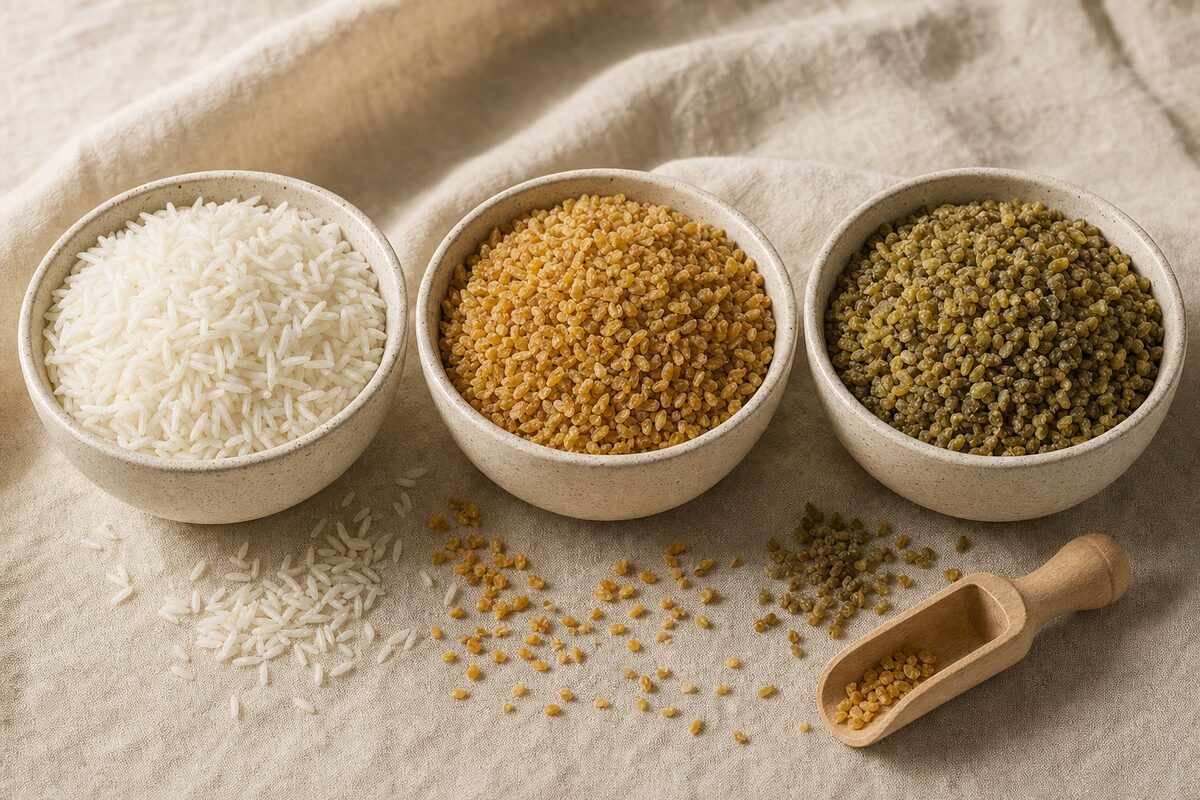
Rice is the grain of the plate: fluffy, fragrant and served under grilled meat. Bulgur is parboiled cracked wheat, which is why fine bulgur can simply be soaked instead of cooked, and it is the backbone of tabouli and kibbe. Freekeh is young green wheat roasted over open fire, which makes it smoky and chewy.
Below is what each one actually is, how long each takes, and which dish calls for which. One note first: rice and bulgur are both on our table, freekeh is not, so read this as a guide to the cuisine rather than a menu.
What is the difference between rice, bulgur and freekeh?
Two of the three are the same plant caught at different moments. Bulgur and freekeh are both wheat, one mature and boiled, one young and burned. Rice is a different grain doing a different job entirely.
| Rice | Bulgur | Freekeh | |
|---|---|---|---|
| What it is | A separate grain, usually long grain in this cuisine | Mature wheat, parboiled, dried and cracked | Young green wheat, roasted over fire, then cracked or left whole |
| Processing | Milled, and rinsed before cooking | Cleaned, boiled, dried, ground, sorted by size | Harvested unripe, sun dried, set alight, rubbed |
| Flavour | Neutral and perfumed by what you add | Nutty, mild, wheaty | Smoky, grassy, deeply savoury |
| Texture | Separate fluffy grains | Soft and fine, or chewy when coarse | Firm and chewy, more bite than either |
| Colour | White or pale gold | Tan | Greenish gold |
| Contains gluten | No | Yes | Yes |
| Classic uses | Under grilled meat, stuffed vegetables, pilaf | Tabouli, kibbe, pilaf, koftas | Soups, pilafs, alongside chicken and lamb |
| Cooks in | About 15 to 18 minutes | 10 minutes, or none at all if fine and soaked | 20 minutes cracked, closer to 45 whole |
Canada’s Food Guide names both of the wheats directly. It lists freekeh among whole grains worth trying alongside farro, amaranth and buckwheat, and suggests adding barley, bulgur and quinoa to soups, salads and stir fries. It also makes the general point that whole grain foods carry more fibre than refined grains, and that eating more fibre is associated with lower risk of stroke, colon cancer, heart disease and type 2 diabetes.
What is bulgur, and is it the same as cracked wheat?
Bulgur is wheat that has been boiled before it was ever cracked, and that one step is what separates it from plain cracked wheat. The Whole Grains Council puts it memorably: bulgur is not a grain of its own, it is a process. Wheat is cleaned, boiled, dried, ground roughly, then sorted by size.
That parboiling is why bulgur behaves the way it does. It is already cooked, so it only needs to be rehydrated. Depending on the grind, it takes as little as ten minutes to boil, and the finest grade does not need heat at all: cover it in cold water or lemon juice, wait, and it is ready.
Plain cracked wheat has skipped the boiling, so it is raw. Swap one for the other in a tabouli and you get a bowl of gritty, uncooked grain. This is the single most common mistake people make with a Middle Eastern recipe.
The grades matter as much as the grain:
- Fine (number 1). For tabouli, where the bulgur is soaked and stays in the background, and for kibbe, where it has to bind with the meat.
- Medium (number 2). For koftas and some salads.
- Coarse (numbers 3 and 4). For pilafs, where you want each grain distinct and chewy, standing in for rice.
Fine bulgur is what makes tabouli work: in a proper tabouli the parsley is the salad and the bulgur is a seasoning, not the other way around. And in kibbe, fine bulgur worked into finely ground beef is what gives the dish a texture no plain meatball has.
What is freekeh, and why does it taste smoky?
Because it is set on fire on purpose. Freekeh is durum wheat harvested while the grain is still green and soft, then deliberately burned in a way that destroys the straw and leaves the kernel.
The FAO’s account of freekeh production in Lebanon describes the process step by step: the wheat is harvested before it fully ripens, piled, sun dried and then carefully set alight so that only the straws and the chaffs burn. The young grains survive the flames because they are still full of water. Then they are rubbed vigorously to release green kernels with a smoky flavour, which is where the name comes from: the Arabic farak, meaning “to rub”.
Freekeh is made across the Levant, in Syria, Lebanon, Jordan and Palestine, as well as in Egypt, Tunisia and parts of Türkiye. In Lebanon’s Bekaa Valley the tradition has been revived by women’s cooperatives, including one in Deir al Ahmar that the FAO names as one of 255 women’s groups supported by a project funded by the Government of Canada. There is a small, real thread between a Canadian government programme and a grain that has been made this way for centuries.
Cooked, freekeh is chewier than bulgur and considerably more assertive. It stands up to lamb, to chicken cooked with warm spices, and to soups where it holds its bite instead of dissolving. It is the grain to reach for when rice would be too polite.
What rice is used in Middle Eastern cooking, and why is it fragrant?
Usually a long grain rice, rinsed hard before cooking, and perfumed in the pot rather than after. In Middle Eastern cooking the aim is separate grains, so the rice is washed until the water runs clear to strip surface starch, and often toasted briefly in a little fat before the water goes in.
The fragrance comes from a few habits rather than a secret ingredient:
- Toasted vermicelli. Fine noodles browned in butter or oil before the rice is added, which gives Levantine rice its familiar flecks of gold and a nutty aroma.
- Warm whole spices. Cinnamon stick, allspice berries, cardamom pods or bay, dropped in whole and removed or ignored later.
- Fat that carries flavour. Butter, ghee or olive oil, depending on the household and the dish.
- A rest at the end. Off the heat, lid on, a folded towel under it. The steam finishes the grains and stops them clumping.
Persian cooking treats rice differently again, and it is worth naming rather than lumping in. There, rice is the centrepiece rather than the bed, parboiled and then steamed so the grains stand apart, with a crisp golden crust formed at the bottom of the pot. That is its own technique and its own tradition, not a variation on the Levantine method.
Which grain goes with which dish?
A short field guide, if you are cooking or trying to read a menu.
- Grilled meat on a plate. Rice, every time. It is the neutral bed that lets the grill and the dips do the talking.
- A herb salad. Fine bulgur, soaked, in small quantity. Enough to give the parsley something to hold onto.
- Anything with ground meat worked by hand. Fine bulgur again, as the binder that makes kibbe and kofta hold together.
- A pilaf with body. Coarse bulgur or freekeh, where you want a grain you can feel between your teeth.
- A soup that has to last. Freekeh, which keeps its texture in liquid far longer than rice does.
- Stuffed vegetables and vine leaves. Rice, usually short or medium grain, so the filling sets rather than falls out.
If you are building a Middle Eastern pantry from scratch, our guide to where to buy Middle Eastern ingredients in the Fraser Valley covers what to stock and where.
Which are gluten free, and which are not?
Only rice. Bulgur and freekeh are both wheat, so both contain gluten, and no amount of processing changes that. Freekeh in particular gets mistaken for a gluten free “ancient grain” because it is unfamiliar and it is sold beside quinoa and buckwheat. It is wheat, harvested young.
Rice is naturally gluten free. As always, how a specific dish is cooked matters as much as the ingredient list, so anyone with celiac disease should ask about the kitchen rather than the grain.
What is on our table, and what is not
Our meals come with fragrant rice, and bulgur wheat is in two things we make: our signature kibbe and our tabouli. Freekeh is not something we cook, and we would rather say so than let a post about grains imply a menu item that does not exist.
Have a look at the full menu, or call (819) 743-5953 to order for pickup here in Abbotsford.
Frequently asked questions
What is the difference between bulgur and freekeh?
Timing and fire. Bulgur is mature wheat that has been parboiled, dried and cracked, so it tastes nutty and cooks in minutes. Freekeh is young green wheat harvested before it ripens, then set alight so the straw burns off, which leaves the kernels smoky and chewy. Both are whole wheat, just caught at different ages.
Is bulgur the same as cracked wheat?
Not quite, and the difference matters when you cook. Both are cracked wheat, but bulgur is parboiled before it is dried and cracked, which is why fine bulgur can simply be soaked in cold water and needs no cooking at all. Plain cracked wheat is raw and needs proper simmering.
Why does freekeh taste smoky?
Because it is literally burned. Green durum wheat is harvested young, piled, sun dried and then set on fire so that only the straw and chaff burn away. The grains survive because they are still full of moisture, and the smoke stays in them. The word comes from the Arabic farak, meaning to rub, which is the step that frees the kernels afterwards.
Which of these grains are gluten free?
Only rice. Bulgur and freekeh are both wheat, so both contain gluten, and neither is safe for anyone with celiac disease. Rice is naturally gluten free, though anyone with a serious sensitivity should still ask about how a specific dish is prepared.
What kind of rice is used in Middle Eastern cooking?
Usually a long grain rice, rinsed until the water runs clear so the grains stay separate rather than sticky. It is often toasted in a little fat with vermicelli before the water goes in, and warm spices such as cinnamon, allspice, cardamom or bay perfume the pot. Persian cooking treats rice very differently again, as the centrepiece rather than the base.
Does Salma's Kitchen serve freekeh?
No. Freekeh is not on our menu. Our meals come with fragrant rice, and bulgur wheat is in both our kibbe and our tabouli. This post is a guide to three grains used across Middle Eastern cooking rather than a list of what we sell.
Salma’s Kitchen cooks Armenian and Middle Eastern food in Abbotsford, BC. See the menu, our catering service areas, or how to order. Phone only: (819) 743-5953.