Journal
Is Middle Eastern Food the Same as Mediterranean Food?
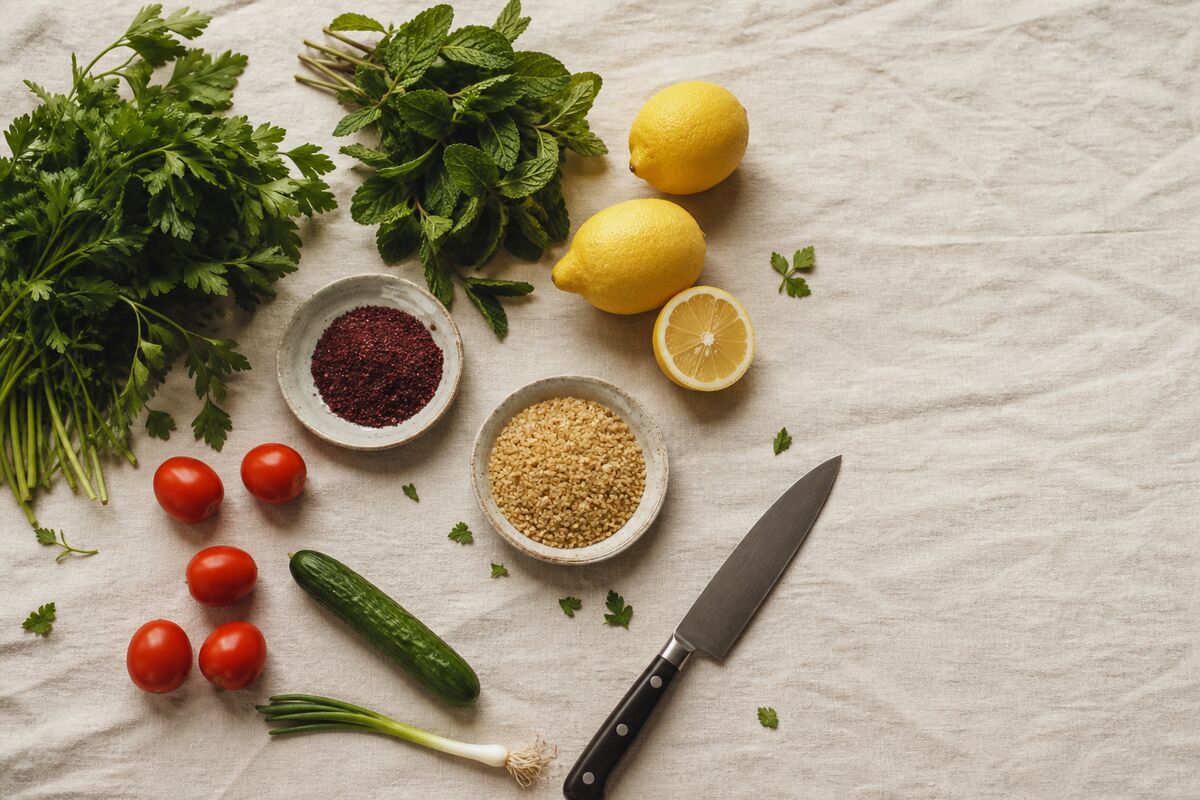
No. Mediterranean is a label for everything around one sea, from Spain and Italy to Greece, Croatia and Morocco. Middle Eastern is a label for a region running east from the Levant through Türkiye, Iraq, Iran and the Gulf, much of which never touches that sea. Greek food is a single national cuisine sitting inside the first.
The labels overlap along one coastline and diverge everywhere else. Here is what each one actually covers, why “Mediterranean” ended up on so many Canadian restaurant signs, and what genuinely is and is not shared.
What do these three labels actually describe?
Three different kinds of thing: a sea, a region, and a country. That is the whole confusion in one line. Once you see that the labels are not the same type of label, the rest follows.
| Mediterranean | Middle Eastern | Greek | |
|---|---|---|---|
| What kind of label | A sea and the coast around it, plus a dietary pattern | A geopolitical region | One national cuisine |
| Roughly covers | Spain, Portugal, southern France, Italy, Croatia, Greece, Cyprus, Türkiye’s coast, the Levantine coast, Egypt, Libya, Tunisia, Algeria, Morocco | Lebanon, Syria, Palestine, Jordan, Iraq, Iran, Türkiye, the Arabian Peninsula, and the Armenian and Kurdish communities within them | Greece and the Greek islands |
| Named after | A body of water | A position on a European map | A country |
| Includes landlocked places | No | Yes, most of it | Not applicable |
| On a menu it usually signals | Olive oil, grilled fish, salads, a health claim | Grilled meat, dips, flatbread, mezze | Oregano, feta, tzatziki, souvlaki, gyros |
| Reliable as a description | Loosely | Loosely | Fairly |
Notice what falls out of that table. Iraq, most of Iran and the Gulf are Middle Eastern and not Mediterranean at all. Spain and Portugal are Mediterranean and in no sense Middle Eastern. Türkiye and Lebanon are both. Greece is one country inside a much larger label. None of these is a subset of another.
Why does “Mediterranean” appear on so many Canadian restaurant signs?
Because it worked as a bridge word, and it worked for a specific historical reason. This is one of the more interesting bits of Canadian food history and it is documented rather than folklore.
The Canadian Encyclopedia’s article on Lebanese food in Canada notes that when Lebanese immigrants opened restaurants here, many Canadians did not yet know what Lebanese food was, so restaurateurs marketed their cuisine as a healthy Mediterranean diet. Lebanon does sit on the Mediterranean, so the claim was accurate. It was also strategic, and it stuck.
The same article records that Canada’s Lebanese diaspora numbered 210,605 people in 2021, the country’s largest Middle Eastern or Southwest Asian population group, and that for years most Canadians’ knowledge of the cuisine ran no further than shawarma, falafel and hummus. A generation of restaurant signs reading “Mediterranean” is part of why. The word opened a door. It also blurred a lot of distinctions on the way through.
What is the Mediterranean diet, and which countries are actually on the list?
Seven, and not one of them is an Arab country of the Levant. UNESCO inscribed the Mediterranean diet on its Representative List of the Intangible Cultural Heritage of Humanity, first in 2010 with Greece, Italy, Morocco and Spain, then extended in 2013 to include Croatia, Cyprus and Portugal.
Lebanon, Syria, Palestine, Jordan and Türkiye all sit on the same sea and eat in recognisably the same way. None of them is on that list. Heritage inscriptions reflect which governments filed which nominations, not which kitchens deserve credit, and that is worth knowing before treating any such list as a ranking.
The other surprise is what UNESCO means by “diet”. Its description is not about macronutrients at all. UNESCO calls the Mediterranean diet “a set of skills, knowledge, rituals, symbols and traditions concerning crops, harvesting, fishing, animal husbandry, conservation, processing, cooking, and particularly the sharing and consumption of food”, and states that “eating together is the foundation of the cultural identity and continuity of communities throughout the Mediterranean basin.”
The word comes from the Greek diaita, meaning a way of living rather than a restriction. So the heritage listing and the health magazine version of the “Mediterranean diet” are talking about two different things, and only one of them is about olive oil.
What makes Greek food its own cuisine?
Its own flavours, its own fasting calendar and its own set of dishes, none of which are borrowed versions of anything. Greek cooking leans on oregano, dill, olive oil, lemon and feta, and its yogurt shows up as tzatziki rather than as the tahini and sumac of the Levantine table.
The Greek Orthodox calendar shapes the food as directly as the Armenian Apostolic calendar shapes Armenian cooking: long fasting periods created a deep repertoire of dishes with no meat or dairy in them, which is why Greek cooking has so many good bean, greens and vegetable dishes that are not afterthoughts.
Greece also shares real history with its eastern neighbours, and pretending otherwise does nobody a favour. Stuffed vine leaves, flaky nut pastries, grilled skewers and meat shaved off a vertical spit all exist on both sides of the Aegean, under related names, because people, empires and refugees moved across it for centuries. We take the same view of these as we do of the dishes Armenians and their neighbours both claim: where several traditions genuinely make a dish, saying so is more honest than picking a winner.
Where do Turkish, Armenian, Levantine and Persian cooking sit?
Side by side, as peers. This is the part the umbrella labels flatten worst, so it is worth setting out plainly:
- Levantine cooking (Lebanon, Syria, Palestine, Jordan) is the mezze heartland: tahini, lemon, garlic, parsley, sumac, olive oil, grilled meat, and a table where everything arrives at once.
- Turkish cooking is its own vast tradition with regional kebab styles, pepper paste, butter, yogurt dishes and a pastry culture of its own. It is not “Greek food with different spices” and it is not a branch of Arab cooking.
- Armenian cooking is wheat first: lavash from a clay tonir oven, bulgur through everything, cured meats like sujuk and basturma, slow grain dishes, and a highland larder of dried wild greens.
- Persian cooking is different again, and the most distinct of the four. Rice is the centrepiece rather than the side, cooked to separate grains with a crisp base. Sourness comes from dried limes, sour plums and pomegranate rather than from lemon alone, and saffron, rose and herbs do work that cumin and paprika do further west.
Four traditions, one neighbourhood. Real overlap, real differences, and no hierarchy among them.
What genuinely overlaps, and what does not?
Shared across most of the region:
- Grilling meat over charcoal, on a skewer or a spit
- Flatbread as a utensil rather than a side. UNESCO inscribed flatbread making and sharing culture in 2016 as a single tradition nominated jointly by Azerbaijan, Iran, Kazakhstan, Kyrgyzstan and Türkiye
- Yogurt in some form, at nearly every meal
- Small plates brought to the middle of the table
- Olive oil, lemon, garlic, parsley, eggplant, chickpeas
Not shared, and often assumed to be:
- Tahini. Central to Levantine cooking, marginal in Greek and Italian.
- Feta. Greek. Levantine cooking has its own cheeses and they behave differently.
- Tomato and pasta. Italian, and a relatively recent arrival even there.
- Chilli heat. Mostly absent from Levantine and Armenian cooking, which is aromatic rather than hot.
- Wine at the table. Normal in Greece and Italy, varies enormously elsewhere for religious reasons.
- Pork. Common in Greek gyros and in Armenian khorovats in Armenia itself, absent from most Levantine menus.
Our note on Middle Eastern breads goes further into the one thing that genuinely does run through the whole region.
Which label should you search for in the Fraser Valley?
Search all three, then read the menu. “Mediterranean” will surface Greek, Italian, Lebanese and Turkish kitchens in one list. “Middle Eastern” will surface a narrower set. Neither term tells you whether a kitchen makes muhammara, lavash or kibbe, and the menu will.
Salma’s Kitchen is Armenian food with a Middle Eastern infusion, cooked in Abbotsford. That phrase is a description of a family history that runs from Armenia through Syria to the Fraser Valley, not a category. Our post on what Middle Eastern food is and where to find it in Abbotsford compares the flavours side by side.
See what that looks like on the full menu, or call (819) 743-5953 to order for pickup.
Frequently asked questions
Is Middle Eastern food the same as Mediterranean food?
No. Mediterranean describes everything around one sea, including Spain, Italy, Greece, Croatia and Morocco. Middle Eastern describes a region that runs east from the Levant through Türkiye, Iraq, Iran and the Gulf, much of which is nowhere near that sea. The two labels overlap along the eastern coast and diverge everywhere else.
Is Greek food Middle Eastern?
No. Greek food is its own national cuisine with its own history, its own church calendar and its own flavours: oregano, dill, feta, olive oil and lemon. It shares the grill, the small plates habit and the flatbread with its eastern neighbours, which is genuine shared history rather than one cuisine being a version of the other.
Why do so many restaurants call themselves Mediterranean?
Partly geography, largely history. The Canadian Encyclopedia records that early Lebanese restaurateurs in Canada marketed their cooking as a healthy Mediterranean diet at a time when many Canadians did not yet know what Lebanese food was. The label was a bridge, and it stuck.
Which countries are on UNESCO's Mediterranean diet list?
Seven: Croatia, Cyprus, Greece, Italy, Morocco, Portugal and Spain. It was first inscribed in 2010 with Greece, Italy, Morocco and Spain, then extended in 2013 to add Croatia, Cyprus and Portugal. No Arab country of the Levant appears on it, which surprises most people.
Is Armenian food Middle Eastern food?
Armenian cooking is its own tradition that has lived alongside Levantine cooking for a century, not a branch of it. The modern Armenian diaspora largely formed in Syria, Lebanon and Egypt, so Armenian kitchens absorbed Levantine ingredients while keeping their own techniques, breads and cured meats.
Is Turkish food the same as Greek food?
No, though they share a great deal, and the overlap is real history rather than borrowing in one direction. Grilled meat, stuffed vine leaves, flaky pastry and yogurt all appear in both. Assigning a single owner to those dishes is usually politics rather than food history.
Salma’s Kitchen cooks Armenian and Middle Eastern food in Abbotsford, BC. See the menu, our catering service areas, or how to order. Phone only: (819) 743-5953.