Journal
How Are Middle Eastern Skewers Actually Grilled, and Why Charcoal?
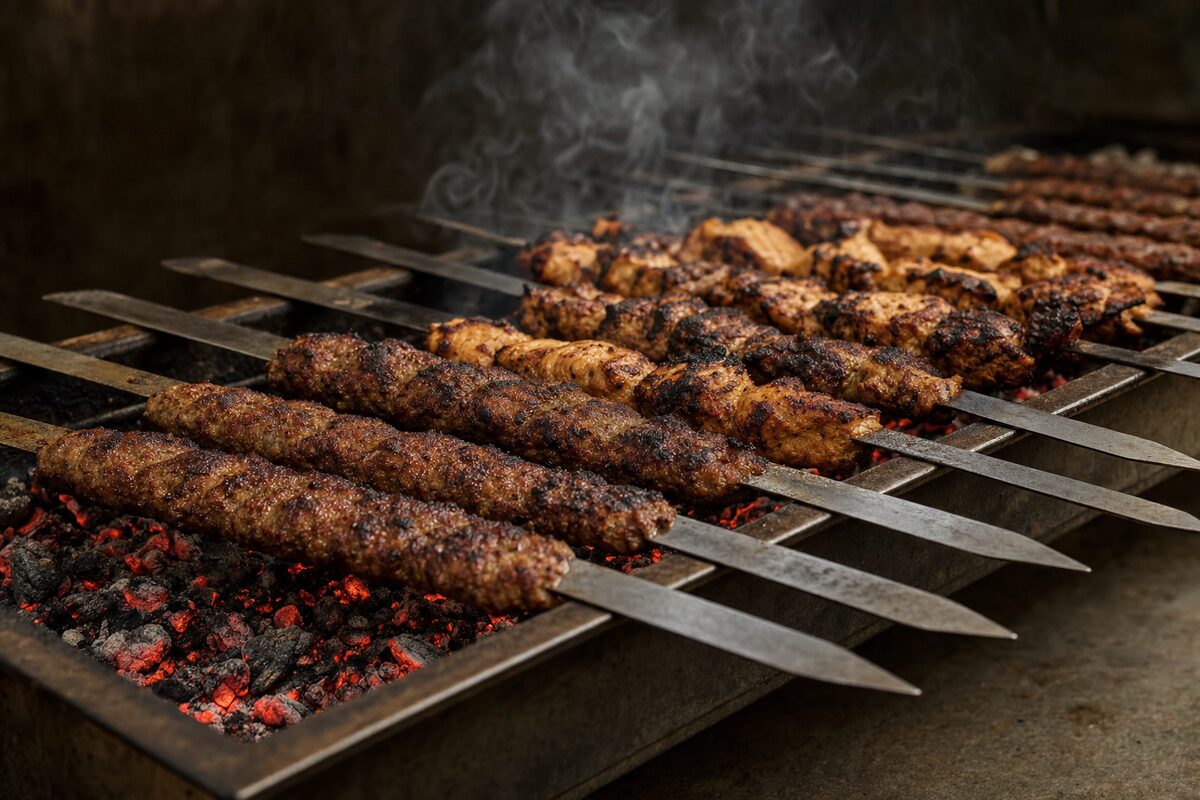
Middle Eastern skewers are cooked on a mangal: a long, narrow charcoal trough with no grate, where the skewers themselves span the rails and the meat sits close over the coals. Charcoal matters because it burns hotter and smokier than gas, and because fat dripping onto live coals vaporises and comes straight back into the meat.
This guide covers the equipment, the skewers, why charcoal behaves differently, and how to know when something is done.
What is a mangal, and why does it have no grate?
A mangal is a long, narrow, open topped charcoal grill, and the missing grate is the whole design idea. Skewers rest across the two long rails, spanning the trough, so the meat hangs in the heat rather than sitting on bars.
Take away the grate and three things change at once. The meat gets closer to the coals, so it sears faster. Fat drips directly onto the charcoal instead of onto a metal grid. And turning becomes a single motion: you roll the skewer, and every face of the meat meets the fire evenly, with no sticking and no tearing.
The narrowness matters too. A mangal is usually only as wide as a skewer is long, which concentrates a small amount of charcoal under exactly the strip of meat that needs it. A wide North American kettle grill spreads heat across a circle. A mangal spends it in a line.
The same logic appears in different forms across the region. In Armenia, khorovats is cooked over embers, often from grape vine cuttings, and in older practice skewers are lowered vertically into a tonir, the clay oven sunk into the ground. In the Levant and Türkiye the mangal is the everyday version, portable and frequently home welded from steel.
Why does charcoal actually make a difference?
Two reasons: the heat is higher and drier at the meat’s surface, and charcoal produces aromatic smoke that gas simply does not.
Grilled flavour is mostly the Maillard reaction, the browning chemistry between amino acids and reducing sugars that Britannica describes as responsible for the flavours of roasted meat, coffee and bread crust. It is generally reckoned to get moving in earnest above roughly 140°C, and it accelerates sharply as surface temperature climbs. A hot charcoal bed drives it harder and faster than a typical gas burner does, which is why charcoal cooked meat browns deeply while its inside is still juicy.
The second half is smoke, and specifically fat. When rendered fat drips onto live coals it flashes into vapour carrying aromatic compounds, which rise and settle back onto the meat. That loop is where most of what people call “charcoal flavour” comes from, which is also why a lean chicken breast picks up far less of it than a fatty kabab does.
| Charcoal | Gas | |
|---|---|---|
| Surface heat | Higher, more intense sear | Lower on most home units |
| Smoke | Aromatic compounds from the fuel and dripping fat | Burns mostly to water vapour and carbon dioxide |
| Control | Managed by coal depth and distance | Managed by a dial |
| Time to ready | 20 to 30 minutes to ash over | A few minutes |
| Flavour loop | Fat drips, vaporises, returns to the meat | Drippings mostly burn off below |
Two practical notes. Lump charcoal lights faster and burns hotter but less evenly; briquettes burn steadier and longer. And whichever you use, wait until the coals are covered in grey ash. Cooking over black, freshly lit charcoal puts raw fuel smoke into the food, and it tastes exactly as bad as that sounds.
What is the difference between flat and round skewers?
Flat skewers grip, round skewers do not, and that single difference decides what you can cook on each.
- Flat, wide skewers hold minced kabab and large cubes still. When you rotate the handle, the meat rotates with it. This is the traditional shape for kofta style minced kabab across the region, and there is no good substitute.
- Round skewers let food spin freely on the shaft. They work for small, firm, dense pieces and are frustrating for anything soft.
- Doubled skewers, two thin ones run through in parallel, are the home cook’s fix for round skewers: the second shaft stops the rotation.
- Wooden skewers need a soak and still char at the ends. They are a home compromise, not what a mangal is built for.
- Length should exceed the width of the grill so the handles stay off the heat and can be turned with bare hands.
Loading matters as much as the metal. Pieces go on snug with no air gaps, because gaps let the fire cook the sides of each cube and dry them out. Meat and vegetables generally go on separate skewers, since a pepper and a chunk of beef do not finish at the same time.
How do you keep minced kabab from falling off the skewer?
Fat, kneading and cold. Minced kabab is a suspension held together by protein and fat, and if any of the three is missing it slides off into the coals.
The fat has to be there in the mix, not added as oil. Lean mince has nothing to bind with and nothing to baste itself with. The mixture then needs to be worked, kneaded and slapped, until it turns visibly tacky, because that is the proteins linking up into a structure that will hold onto a metal blade.
Then keep it cold. Warm fat softens, the mixture loosens, and it lets go of the skewer the moment it meets heat. Chill the mix, wet your hands, and press it along a flat skewer in one continuous sleeve, squeezing gently so there are no hollow pockets underneath.
On the fire, leave it alone at first. Kabab needs to set a crust before it is turned, and moving it in the first minute is the single most common way to lose it. If you want the difference between minced kabab and cubed chicken spelled out, our shish tawook versus kabab comparison covers it.
Why is chicken for shish tawook marinated in yogurt?
Because yogurt does three jobs at once that a simple oil and lemon marinade cannot.
It tenderises gently. The acidity is mild compared with straight lemon juice or vinegar, so it softens the surface of the meat without turning it chalky the way a long acid soak does. Chicken breast, which has very little margin for error, benefits from that mildness more than almost anything else on a grill.
It clings. Yogurt is thick, so it stays on the meat through skewering instead of running off, carrying the garlic, lemon, paprika and spices with it and holding them against the surface where the browning happens.
And it browns. Milk proteins and lactose on the surface of the meat contribute to colour and crust under high heat, which is part of why properly marinated chicken comes off a charcoal grill golden rather than pale.
Time it sensibly. A few hours to overnight is the usual window. Much longer and the texture starts to go soft and mealy at the surface.
How do you know when meat off a skewer is done?
By temperature, not by colour, and minced meat is held to a stricter standard than whole cuts. Health Canada’s safe internal cooking temperatures are the numbers to work to:
- Ground beef, including minced kabab: 71°C (160°F). Grinding spreads surface bacteria through the whole mixture, which is why a kabab is not treated like a steak even though it looks like one.
- Poultry pieces, including chicken for skewers: 74°C (165°F).
- Whole cuts of beef: 63°C (145°F) for medium rare.
Two habits make this easier on a mangal. Build the fire with a hotter end and a cooler end, so a skewer that is browning too fast has somewhere to go. And let the meat rest for a few minutes after it comes off, which lets the juices redistribute instead of running out on the first cut.
What goes alongside skewers at the table?
Bread underneath, something sharp beside, something cold to drink. That is the standard arrangement almost everywhere skewers are grilled.
Flatbread does real work here: a folded piece is used to grip the meat and pull it off the skewer in one motion, and the bread underneath catches the juices. Our guide to Middle Eastern breads covers which breads suit which job. Sliced onion tossed with sumac and parsley is the classic sharp counterpoint, cutting the fat between bites. And ayran, the salted yogurt drink, is the traditional partner for anything rich off the fire.
Everything else on the table follows the same shared logic as a mezze spread: dips and salads land first and stay, the grilled skewers arrive in waves, and people keep reaching in.
Fire, metal and patience
A mangal is a trough, a bag of charcoal and a handful of flat steel skewers. There is no trick beyond hot ashed-over coals, meat that is loaded properly, and the discipline to leave it alone until it has set a crust.
See what comes off our grill on the menu, or call (819) 743-5953 to order or to talk about a catering spread anywhere in the Fraser Valley.
Frequently asked questions
What is a mangal?
A mangal is the long, narrow charcoal grill used across the Middle East, Türkiye, Armenia and the Caucasus. It has no grate. The skewers rest on the two long rails and span the trough, so the meat sits directly over the coals and is turned by rotating the skewer rather than flipping it with tongs.
Why do Middle Eastern grills have no grate?
Because a grate is only useful if food sits loose on it. With everything on skewers, the skewer is the grate. Removing it puts the meat closer to the coals, lets fat drip straight down onto them, and means one turn of the wrist rotates the whole skewer evenly instead of dragging meat across bars.
Does charcoal really taste different from gas?
Yes, and the mechanism is understood. Charcoal burns solid carbon plus traces of wood compounds, throwing off aromatic smoke that gas does not produce, and it typically runs hotter at the surface. Fat dripping onto hot coals vaporises and rises back into the meat, which is where most of the grilled flavour actually comes from.
What is the difference between flat and round skewers?
Flat skewers grip. A wide flat blade holds minced meat and larger cubes still so they turn with the skewer instead of spinning loose. Round skewers let food rotate freely, which is fine for small firm pieces and hopeless for kofta style minced kabab.
Why does minced kabab fall off the skewer?
Usually too little fat, too little kneading, or meat that got warm. Minced kabab needs enough fat to bind, needs working until the proteins turn tacky, and needs to stay cold until it hits the fire. Pressing it onto a flat skewer with no air gaps is the last piece.
What internal temperature should grilled meat reach?
Health Canada gives 71°C (160°F) for ground beef, 74°C (165°F) for poultry pieces, and 63°C (145°F) for whole cuts of beef. Minced kabab counts as ground meat, not as steak, so it needs the higher number even though it looks like a piece of meat on a stick.
Salma’s Kitchen cooks Armenian and Middle Eastern food in Abbotsford, BC. See the menu, our catering service areas, or how to order. Phone only: (819) 743-5953.